
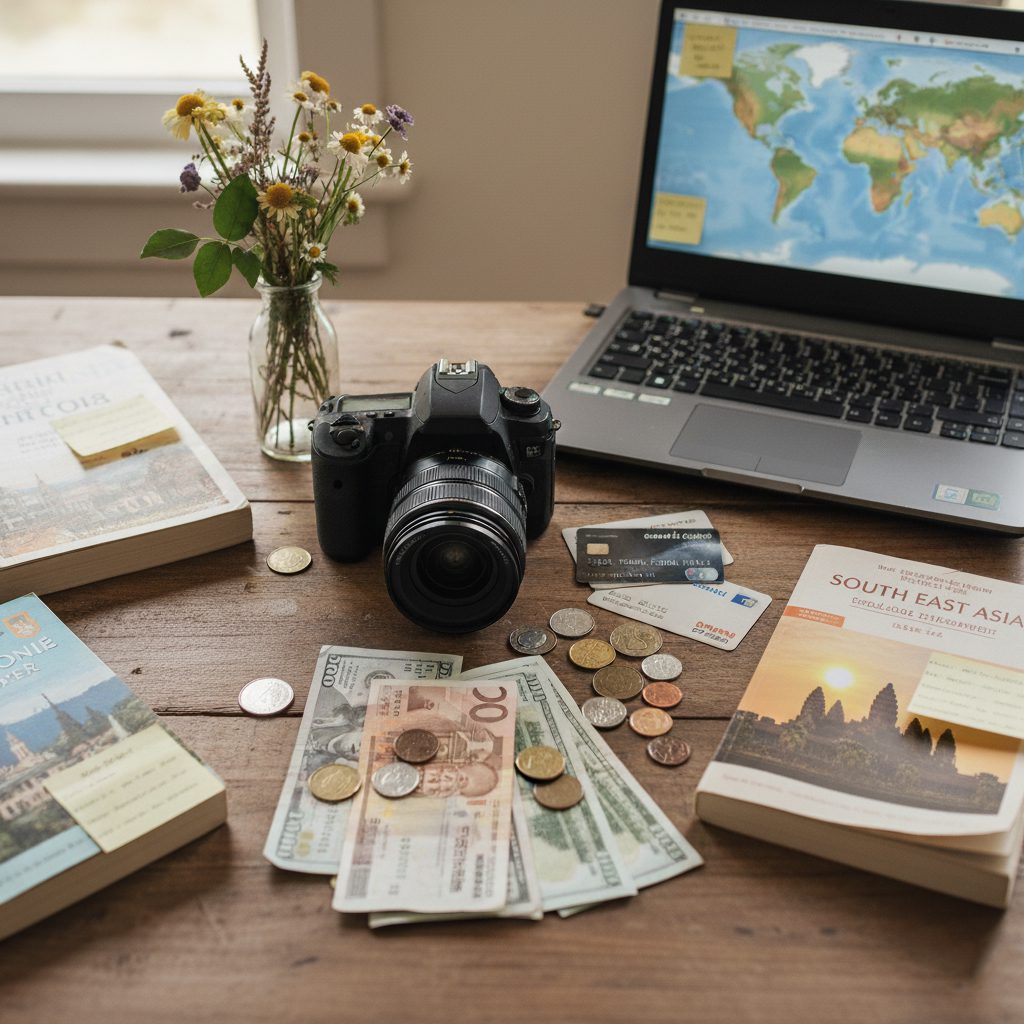
No matter whether you are an occasional traveller or a digital nomad, whenever you go abroad you want to make sure you are able to make payments effortlessly. Ideally without spending a small fortune on fees.
You have probably at least once found yourself standing in front of a blinking ATM screen or a credit card reader at a register in a foreign country wondering if you’re about to get charged quarter of your daily budget in fees, so you know how crucial it is to be informed. There are certainly better ways to spend your money on than bank fees. 🙂
Payments abroad are often the hidden stress factor of travel and I am here to make it less of a hustle for you by covering the basics and sharing my approach during travels.
Choosing the right payment methods while travelling is essential for smooth, stress-free trips. From cash and cards to mobile wallets and digital banking, travellers today have more options than ever—but not all payment methods work equally well in every destination.
This article breaks down the best ways to pay while traveling internationally, including pros, cons, and practical tips.
Overview of the Payment Options for Travelling
In general, paying abroad often times looks very similar to how you do it at home, obviously with a few distinctions and (mostly) extra fees.
Here is an overview of the most common solutions for handling your money while travelling:
1. Cash
Cash remains one of the most reliable travel payment methods worldwide, especially outside major cities.
Best for:
Street food, local markets, small businesses
Public transport, taxi and tips
Rural and remote destinations
Pros:
Accepted almost everywhere
No card or processing fees
Cons:
Risk of loss or theft
Poor exchange rates at airports and hotels
PRO TIP
Travel with a card that doesn’t charge for withdrawals abroad or charges only a small fee. Always withdraw and pay in local currency for better exchange rates when traveling abroad.
2. Debit Cards or Prepaid Credit Cards
Debit cards are one of the most common ways to pay while traveling abroad.
Best for:
ATM withdrawals
Daily spending & hotel reservations
Online payments in same currency
Pros:
Competitive exchange rates
Easy expense tracking
Cons:
Foreign ATM and transaction fees
Possible card blocks due to fraud prevention
PRO TIP
Always travel with at least two debit cards stored separately. Research in advance which card is best to use for low ATM fees (or no fees at all).
3. Credit Cards
Credit cards are ideal for larger expenses and offer extra protection.
Best for:
Large purchases
Flights bookings and car rentals
Emergencies
Pros:
Fraud protection
Travel insurance and purchase protection
Cons:
Not accepted everywhere
PRO TIP
Choose credit cards with no / low foreign transaction fees when traveling internationally. Both VISA and MasterCard are widely accepted in places where you can pay with a card (with VISA having a slightly larger presence worldwide).
4. Mobile Payments and Digital Wallets While Traveling
Mobile payments are becoming increasingly popular, especially in urban areas. Nowadays, in many places across Europe you can pay with Apple Pay / Google Pay as easily as with your card. For China you may want to look into setting up AliPay and WeChat Pay. In the meantime, in South East Asia payments with a use of a QR codes are gaining popularity.
EXTRA TIP
To use the QR payment method in Asia you often need to use a third party provider app which allows you to use a wallet in the local currency, linked to either your bank account or credit card. Such third party apps (like Momo, Moreta, TrueMoney, GCash etc.) usually charge fees for conversion, toping up your wallet and /or the transactions you make through the app (normally somewhere around 2-3%).
Best for:
Small daily purchases (supermarkets)
Online payments & food/taxi order
Pros:
Contactless and convenient
Reduced risk of card skimming & quick to set up
Cons:
Requires battery, internet and compatible terminals
Limited acceptance in some countries
5. Online Payment Platforms
Digital platforms (a.k.a. online banks) are useful for a variety of financial operations from money transfer to online & offline payments while travelling. Some of the biggest current player on the market are Wise, Revolut & PayPal.
Best for:
Booking accommodation and transport
International money transfers
Multi-currency management & convertion
Pros:
Easy to set up & fast transfer execution
Quick access to a virtual credit card
Cons:
Not suitable for in-person payments
Account restrictions may apply
6. Prepaid Travel Cash Cards
Basically the same as prepaid credit or debit card, but the money on the card is normally insured. If you travel to a place with a high risk of robbery and theft – you may want to look into it. However, these cards normally come with extra transaction costs as well as fees for topping up your card.
7. Cryptocurrency
Cryptocurrency remains a niche payment option for travellers, but interest is growing. While this may work for a few tech-forward destinations like Singapore and the UAE, this payment method is highly under-explored in the majority of the world.
How To Choose The Most Suitable Card For Payments Abroad?
Rule number one in travel finance: redundancy. Always carry at least two bank cards (ideally from different providers). Why? Because cards can get blocked, machines can reject them (or swallow them – yes, that happens!), or – let’s be real – sometimes we just lose stuff, or (touch wood this never happens) your wallet gets stolen.
In general, you want to use a variety of payment methods and educate yourself in advance about the fees you will be facing – and based on that, you decide which payment method makes sense for every transaction.
Which Payment Methods Are Best To Use While Travelling?
So, let’s break it down: how do you pay abroad smartly, without losing your hard-earned money to shady conversion rates and unnecessary bank fees?
Based on my experience, the ideal combo for the payments abroad is:
• One main card for cash withdrawals with zero ATM fees worldwide or at least in your destination country.
If you are a resident of Switzerland, Germany or Austria (regardless of your nationality) – I highly recommend DKB, as it allows you to withdraw cash worldwide without any fees (see more detailed information on this below).
• One backup card with zero or low fees for ATM withdrawals.
This can be a travel card of your partner with the same provider or your card with a different bank. I recommend to use Wise or Revolut as your backup as they allow cash withdrawals for free up to a certain monthly limit.
• Several virtual Visa and / or Mastercard cards linked to your smartphone wallet.
• Small amount of cash (CHF / EUR / USD / JPY or any other widely accepted currency).
In some places currency exchange points might be the only options for you to get to the local money, so good thing to have as a backup).
This combo has saved me countless times – from street food stalls in the Philippines to charming family tavernas in Greece where “card reader is currently offline” really means “cash only, sorry.”
💳 Best for Worldwide Payments: Wise
Best for: everyday card payments, online bookings, and paying in shops/restaurants abroad. Can be used as a cash withdrawal card for smaller amounts and/or as a backup card for cash withdrawals.
Here’s the deal with Wise: their mid-market exchange rates are basically unbeatable. No tourist markups, no “surprise conversion fees” hidden in the small print. You get the real exchange rate you before you make the conversion. I also absolutely love their feature for automatic currency conversions: you don’t need to track the exchange rate fluctuations and simply define the desired amount to convert at the preferred rate and it will be converted for you automatically once the threshold is reached!
Highlights:
• Free multi-currency account: hold money in different currencies and pay like a local. This has proven to be especially useful in the Philippines a few times, when I had to make a transfer quickly.
• Transparent low fees with discounts for larger transfers.
• Works perfectly with Apple Pay & Google Pay.
• Quick execution time.
• Automatic currency conversion.
The virtual card is free (you can also get several cards at the same time). You can control the card online and quickly block / unblock it if needed at no extra cost.
Currently Wise is available in the following countries:
• Australia
• Brazil
• Canada
• EEA + Switzerland
• Japan
• Malaysia
• New Zealand
• Philippines
• Singapore
• UK + European microstates and overseas territories*
• USA except for residents of Nevada
For the current list of available countries check on the official website here.
Cash Withdrawal
You can also use your Wise card for cash withdrawal (or at least as a backup card). You can order a physical card for a one time fee of 7 EUR with no further monthly costs. Each month you will get 2 free cash withdrawals abroad for the amount of up to 200 EUR (which you can split into 2 withdrawals for free, or for 3 or more withdrawals you will pay 0.5 EUR per withdrawal). If you withdraw more than 200 EUR monthly, you will pay 1.75% of the withdrawal amount in fees for up to 2 withdrawals, for every consecutive withdrawal there is a surcharge of 0.5 EUR per withdrawal on top.
I am sharing with you a link* through which you can get a FREE card OR an option to send transfers for up to 600 CHF with ZERO fees:
👉 Sign up for Wise here*.
*This affiliate link gives you a bonus while giving me an extra income with no cost to you. Win-win! 🙂
🏧 Best for Cash Withdrawals Worldwide: DKB Visa (For CH, DE, AU Residents Only)
Best for: worldwide cash withdrawal, online and offline payments in Europe.
Even in 2025, cash is still king in many places – especially in smaller towns, markets, or island ferries. And that’s where DKB Visa comes in. If you’re a European traveller, DKB is one of the most reliable banks offering free worldwide cash withdrawals for the members with active status, which will help you save on the fees massively.
Highlights:
• Free ATM withdrawals worldwide (yes, really free – no foreign transaction fees induced by the bank, BUT provided you have an active member status).
• Works even in tiny rural ATMs – you will get a free Visa Debit Card which is accepted in most ATMs.
• Linked to a solid German bank, with mobile banking that’s easy to use.
Now let’s look at how to avoid fees at DKB:
DKB account is free for everyone under 28. For the rest, to keep your account free of charge all you need to do is secure a transfer of a minimum of 700 EUR per month. Otherwise, it costs you 4.50 EUR during the month you did not make a transfer of 700 EUR or more.
In order to profit from the free cash withdrawals you need to be an active member. Active status is granted once you’ve done 3 consequent monthly transfers of at least 700 EUR and then you keep your active status by keeping the monthly transfer of at least 700 EUR per month. All new clients get an active status right away for 3 months! So if you want to keep it – just keep the monthly 700 EUR transfer in place.
I have been an active user of this bank and can totally recommend it! The only drawback – if you don’t speak German, the user experience might be rather challenging. Their app is, however, user-friendly and has an English version, so shouldn’t be too tricky.
Ready to open an account with DKB? I am sharing with you a link* through which you can also get a 25 EUR bonus either on your new DKB account or as an AMAZON.DE voucher:
👉 Get your DKB account here* and receive 25 EUR as a reward.
*This affiliate link gives you a bonus while giving me an extra income with no cost to you. Win-win! 🙂
Further Great Payment Options For Your Future Trips Abroad
• N26 – another great option for travellers. Opening a bank account is free with a free virtual card included. The standard plan is basic but works well for payments in Europe. For travels outside of Europe you are better of with the plans N26 Go (9.90 EUR / month) or N26 Metal (16.90 EUR / month) are way better options, allowing you to withdraw cash worldwide without extra fees, as well as give you access to further products, such as accident and travel insurance, airport lounge passes and travel eSim plans – all in one app! The bank account opening is eligible to residents of EEA countries – check the complete list here.
• Revolut – good for payments in Europe and worldwide, same currency transfer operations are usually free. Offers a free physical (with delivery fees, otherwise you also often find promotions at European airports where you get a physical card right away). Similar to Wise, Revolut offers a 200 EUR zero-fee withdrawal per month (the amount can be split in up to 5 withdrawals); the following withdrawals are subject to a 2% fee with a minimum fee of 1 EUR. So it can also serve well as a backup cash withdrawal card. The services are available for EU- and non-EU residents – check the complete list here.
Tips For Saving Money On Payments Abroad
• Always withdraw cash in local currency.
Your bank will always give a better exchange rate than an ATM. When an ATM or card machine asks, “Pay in EUR or local currency?” – always choose local currency. Paying in EUR lets the bank set its own (terrible) exchange rate.
• Withdraw larger sums less often: some ATMs charge fixed fees per withdrawal.
• Research in advance which banks do not charge withdrawal fees in your travel destination, or those that have the lowest fees.
• Always pay in local currency when using your card.
This is mainly applicable for offline payments in stores and restaurants. It may seem like the difference is not that big sometimes but over time you may lose quite some money just on high conversion fees offered by the card readers.
• Split money between travellers.
This way if one card is lost, stolen, gets blocked or dysfunctions, it doesn’t ruin the trip.
Final Thoughts: Travel Smart, Spend Smart
Payments abroad don’t have to be a stress factor. With the right combo you’ll have the best of both worlds: low fees, great exchange rates, and peace of mind.
Because let’s face it: I’d much rather spend my travel budget on fresh seafood by the beach or that extra ferry ticket to a secret island, than on unnecessary banking fees.
Affiliate disclosure: Some links on this website are affiliate links. If you use them, I may earn a small commission at absolutely no extra cost to you. This supports my efforts in sharing travel tips! Thanks 🙂